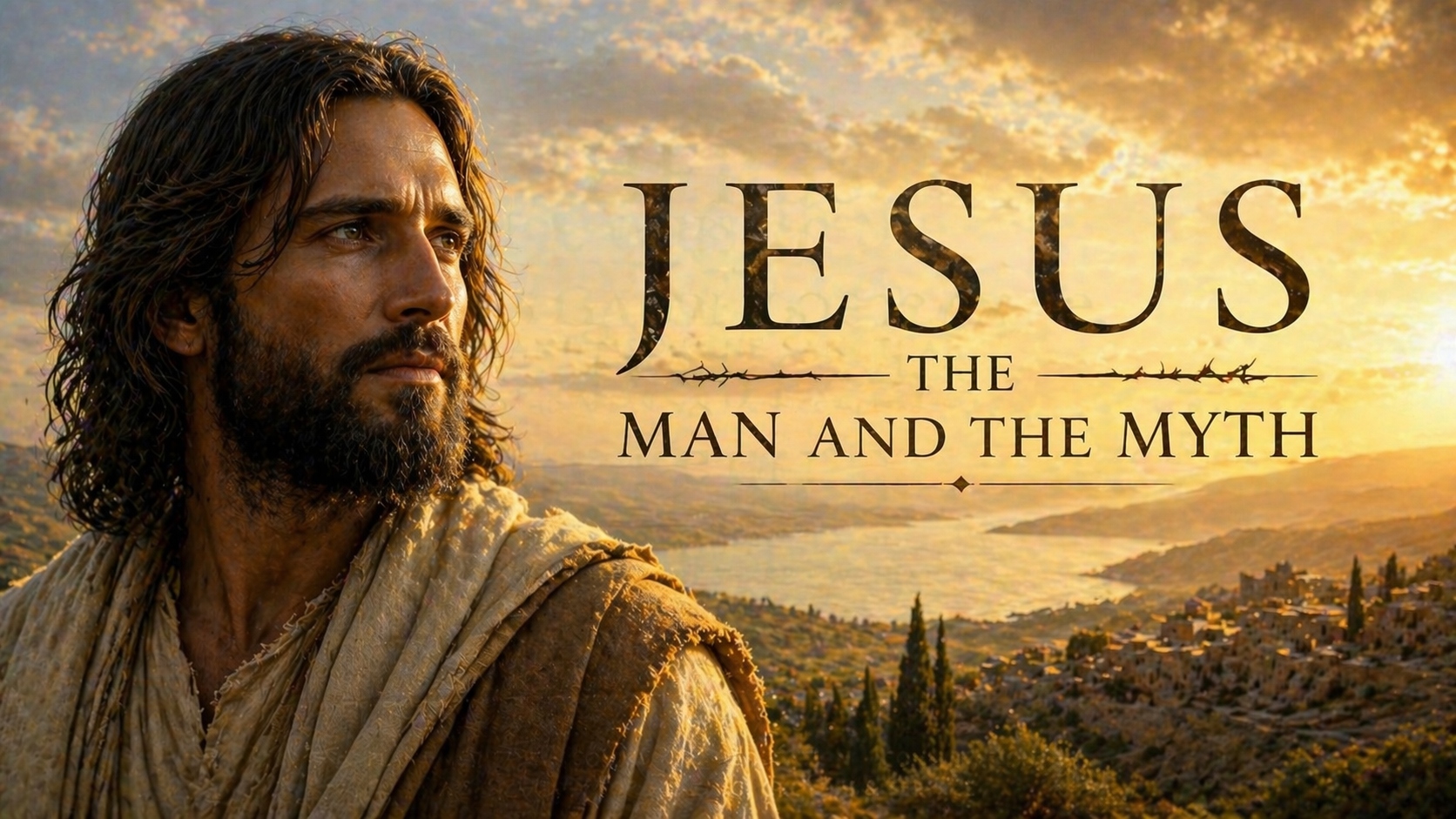
Jesus: The Man & The Myth
Jesus: The Man & The Myth
Stripping away the legend to find the wisdom that was always there
Before You Dismiss This — Or Agree With It
What you are about to read may unsettle you. Good. Unsettled ground is where real seeds take root.
This is not an attack on faith. It is an invitation to go deeper than the version of the story most of us were handed. Because when you look honestly at the historical record, at ancient mythology, at the patterns that repeat across thousands of years of human spiritual storytelling, a fascinating picture emerges.
And at the center of it, once you clear away the centuries of legend and institutionalized doctrine, stands a man whose actual teachings are so powerful, so radical, so urgently needed right now, that they deserve to be taken far more seriously than the mythology surrounding them.
His name was not Jesus. It was Yeshua.
The Story You Know — And Where It Came From
The mainstream Christian narrative goes like this: a virgin named Mary conceived a child through divine intervention. That child was born in Bethlehem, announced by a star, visited by wise men, destined to save humanity. He was crucified, died, and rose from the dead on the third day. He ascended to heaven, where he sits at the right hand of God.
It is a breathtaking story. It is also, in its specific details, a story that was already very old before Yeshua was born.
The documentary film Zeitgeist brought this into popular conversation and sparked a firestorm. Critics pushed back. Scholars debated the finer points. But the core observation — that the Jesus narrative borrows heavily from far older mythological traditions — is not fringe thinking. It is history.
Ask yourself honestly: if the same story existed centuries before Jesus was born, what does that tell you about the story?
Born of a Virgin, Risen on the Third Day — Sound Familiar?
Consider Horus, the Egyptian sun deity, worshipped for thousands of years before the Common Era. Horus was said to be born of the virgin Isis, his birth announced by a star in the east, attended by three kings. He was baptized at age thirty, had twelve disciples, performed miracles, was crucified, and rose from the dead after three days. He was called the Light of the World, the Good Shepherd, the Lamb of God.
Then there is Mithra, the Persian deity popular throughout the Roman Empire in the centuries around Jesus’s birth. Mithra was born on December 25th, born of a virgin, surrounded by shepherds, had twelve companions, performed miracles, and upon his death was resurrected. His followers shared a sacred meal of bread and wine. His holy day was Sunday.
Dionysus of Greece. Krishna of India. Attis of Phrygia. Osiris of Egypt. The pattern repeats across cultures, across centuries, across continents that had no contact with one another. Virgin birth. Star in the east. December 25th. Twelve disciples. Death and resurrection. Three days in the tomb.
These are not coincidences. They are the fingerprints of something much older: the ancient astrological and astronomical cycles that our ancestors used to understand the cosmos and their place within it.
The sun dies at the winter solstice. It is ‘dead’ for three days. Then it is reborn, rising earlier each morning. Sound familiar?
The twelve disciples mirror the twelve signs of the zodiac. The star in the east is Sirius, the brightest star in the night sky, which on December 24th aligns with the three stars of Orion’s belt — known historically as the Three Kings — and together they point directly to the sunrise on December 25th. The immaculate conception mirrors the ancient motif of the sun god born from the constellation Virgo, the virgin, on the horizon.
These stories were not invented to deceive. They were the language through which ancient people expressed profound truths about nature, time, death, and renewal. They were sacred poetry. The problem is that somewhere along the way, the poetry was declared to be literal history — and everything that followed flowed from that foundational confusion.
So Does That Mean None of It Is Real?
Here is where we have to be careful, because the mythology question and the historical question are two different conversations.
Most serious historians, including secular ones, accept that a Jewish teacher named Yeshua bar Yosef — Jesus, son of Joseph — walked the roads of first-century Galilee. He gathered followers. He challenged the religious authorities of his day. He was executed by Roman crucifixion, a common fate for political dissidents.
What followed his death was extraordinary. His followers, shattered and scattered, began having experiences they could only describe as encountering him alive. A movement ignited. And over the next three centuries, that movement was shaped, codified, and eventually weaponized by empires, councils, and institutions that had their own interests in controlling the story.
Much of what we call Christianity today is not the teaching of Yeshua. It is the teaching of institutions about Yeshua. There is a meaningful difference.
Strip away the mythology. Strip away the institutional doctrine. What is left? Something luminous.
The Man Behind the Myth
Yeshua was, by any honest reckoning, one of the most remarkable philosophical and spiritual minds in recorded history. Whether or not you believe in his divinity, the wisdom attributed to him stands on its own.
He was a man who understood something that most of us spend our entire lives circling around without ever quite landing on: that the kingdom of heaven is not a destination. It is a condition. It lives inside you, right now, beneath the noise and the fear and the striving.
“The kingdom of God is within you,” he said (Luke 17:21). Not above you. Not waiting for you after death. Within you.
He understood that we are all children of the same divine source. That the separation we feel from God, from each other, from our own deepest nature — is an illusion we have collectively agreed to believe. He came, again and again in his teachings, back to the same essential truths.
The Teachings That Actually Matter
Love yourself. This is not the selfishness the world sometimes mistakes it for. It is the foundation. You cannot pour from an empty vessel. You cannot offer to another what you have never given to yourself. Yeshua understood that self-love and love of neighbor are not competing values — they are the same movement, expressed in two directions.
Love thy neighbor as thyself. Not more than yourself. As yourself. Because at the deepest level, your neighbor is yourself. The boundary between us is thinner than we think.
Do unto others as you would have them do unto you. The Golden Rule. It appears in virtually every wisdom tradition on earth — in Confucianism, in Islam, in Buddhism, in Judaism, in Hinduism. Yeshua did not invent it. He embodied it, taught it with a radical consistency that ultimately cost him his life.
And this: the kingdom of heaven is within you. Meaning that anyone — anyone — who brings genuine love and understanding into a situation is already living inside that kingdom. Not after death. Now. In this moment. In this conversation. In this choice.
Love heals all wounds. Not as a greeting card sentiment — but as a lived, practiced, daily discipline that transforms everything it touches.
These are not doctrines that require you to believe in a virgin birth. They do not depend on the resurrection being literal history. They stand entirely on their own, and they work. Two thousand years of human experience confirms it.
What We Are Left With
Most of the dramatic details of the Jesus story — the miraculous birth, the star, the three kings, the resurrection on the third day — are almost certainly the ancient mythological language of the age, borrowed and adapted by a community trying to express the magnitude of what they believed they had encountered in Yeshua.
That does not diminish Yeshua. If anything, it makes him more remarkable. Because the real miracle is not the mythology that surrounded him. The real miracle is that a man walked this earth and spoke truths so clear, so deep, so enduringly practical that billions of people across two thousand years have organized their entire lives around them.
He was a philosopher of the highest order. A spiritual teacher without equal. A man who looked at a broken, fearful, divided world and said: the answer is already inside you. Love is the answer. Give it freely. Receive it graciously. Live it daily.
That message did not need myth to be powerful. It was always enough on its own.
Join Us at Garden of Eden Ministry
At Garden of Eden Ministry, we believe faith is not diminished by honest questions — it is deepened by them. We are a community that takes the wisdom of Yeshua seriously enough to engage with it fully, without needing the mythology to be literally true in order to find the teachings profoundly, life-changingly real.
We believe the kingdom of heaven is within you. We believe you are a child of the divine. We believe love heals all wounds and that the Golden Rule, lived sincerely, can transform any life and any community.
If this resonates with you, we would love to have you walk with us. Come as you are. Come with your doubts and your questions and your half-formed faith. There is room for all of it here.
The kingdom is within you. It always has been.
— Minister DonCarlos, Garden of Eden Ministry
Join Our Community
Become a member to access exclusive events, workshops, and our ministry community.
Become a Member →