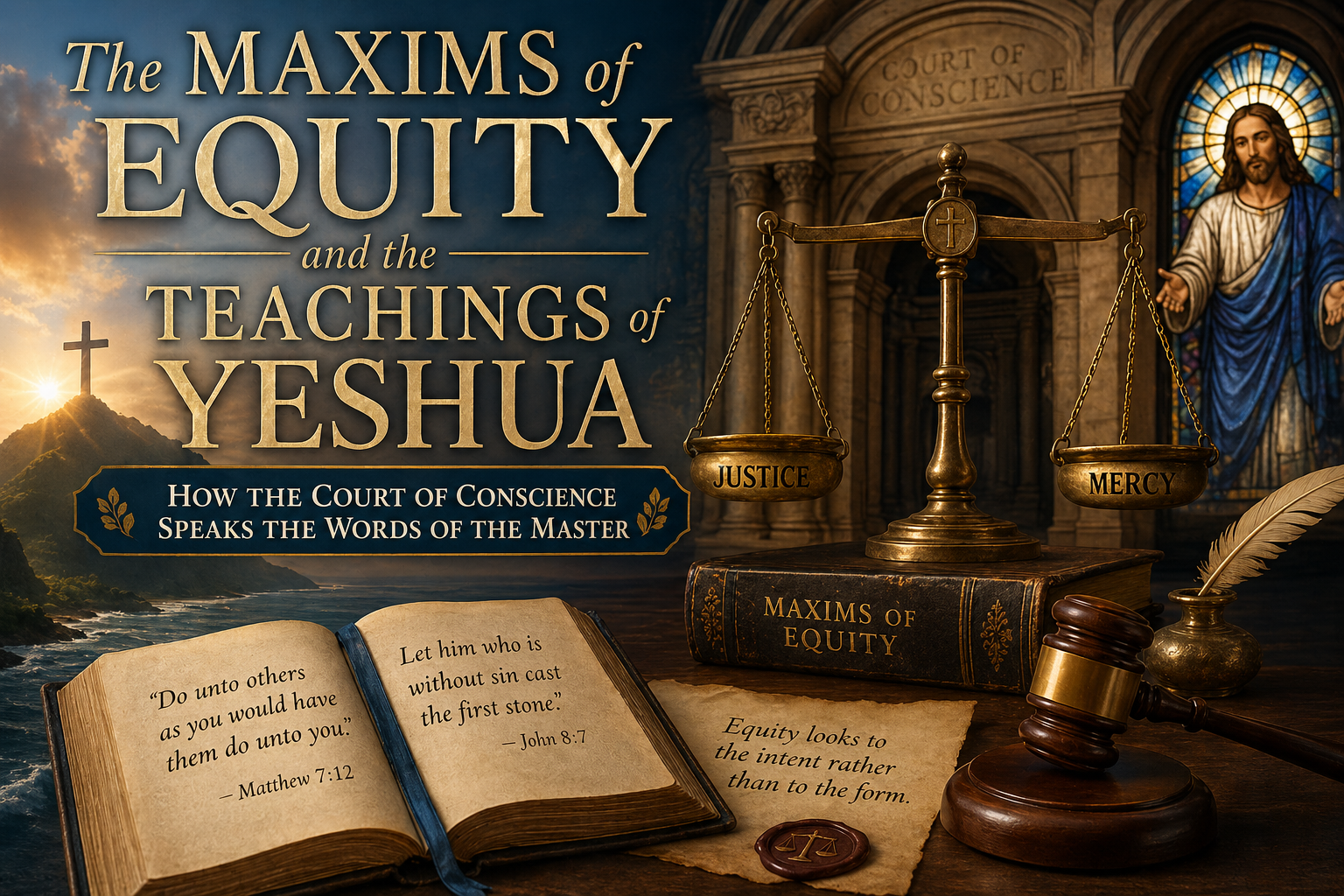
Maxims of Equity embedded in the Bible
The Maxims of Equity and the Teachings of Yeshua
How the Court of Conscience Speaks the Words of the Master
For more than five centuries, the courts of equity in England developed a body of guiding principles known as the maxims of equity. They were not legislated. They were not invented by kings or parliaments. They emerged from the deliberations of the Lord Chancellor's Court of Chancery — the "Court of Conscience" — where, until the modern era, the Chancellor was almost always a clergyman. The maxims were the conscience of the law speaking back to the law itself.
What we discover, when we lay the maxims of equity beside the teachings of Yeshua, is that they are saying the same things in different languages. The lawyers say "He who comes into equity must come with clean hands." Yeshua says "Let him who is without sin cast the first stone." The lawyers say "He who seeks equity must do equity." Yeshua says "Do unto others as you would have them do unto you." These are not parallel inventions. They are the same river running in two channels.
Below are the principal maxims of equity, each with the teaching of Yeshua — and where appropriate the wider witness of Scripture — that gave the maxim its breath.
1. He who seeks equity must do equity.
The plaintiff who comes asking the court for fair treatment must himself have offered fair treatment. Equity is not a fountain that gives without receiving. It is a relationship.
"So whatever you wish that others would do to you, do also to them, for this is the Law and the Prophets." — Matthew 7:12
"Be merciful, even as your Father is merciful." — Luke 6:36
If a man wants mercy from heaven, he must extend mercy to his neighbor. If a man wants the court to deal kindly with him, he must have dealt kindly with the man across the table. The Golden Rule is the heart of equity.
2. He who comes into equity must come with clean hands.
A petitioner whose own conduct is wrongful in the matter at issue cannot ask the court to exercise its discretionary mercy on his behalf. The court will not lend its strength to a hypocrite.
"Let him who is without sin among you be the first to throw a stone at her." — John 8:7
"Why do you see the speck that is in your brother's eye, but do not notice the log that is in your own eye? You hypocrite, first take the log out of your own eye, and then you will see clearly to take the speck out of your brother's eye." — Matthew 7:3, 5
The court of equity is not interested in punishing wrong abstractly. It is interested in the cleanness of the one who is asking. Yeshua's hand drawing in the dust silenced a circle of accusers because not one of them had standing to throw the first stone.
3. Equity follows the law. (Aequitas sequitur legem.)
Equity does not abolish the law. It works alongside the law, supplementing where the law is silent, softening where the law would be harsh, but never destroying.
"Do not think that I have come to abolish the Law or the Prophets; I have not come to abolish them but to fulfill them." — Matthew 5:17
"Therefore render to Caesar the things that are Caesar's, and to God the things that are God's." — Matthew 22:21
Yeshua honored the law and went beyond it. So does equity. The law fixes the rule; equity tempers it with mercy. Neither cancels the other.
4. Equality is equity. (Aequitas est quasi aequalitas.)
Where two parties stand alike, the court will not lift one above the other. Equity loves balance and shares burdens fairly.
"You shall love your neighbor as yourself." — Matthew 22:39
"Each of these last worked only one hour, and you have made them equal to us who have borne the burden of the day and the scorching heat. … Take what belongs to you and go. I choose to give to this last worker as I give to you." — Matthew 20:12, 14 (the laborers in the vineyard)
The vineyard owner gave each worker a denarius. The early workers complained, but the master replied that his generosity was not a wrong against them — it was equality, freely chosen. So it is in equity. Where rights are equal, treatment must be equal.
5. Delay defeats equity. (Equity aids the vigilant, not those who slumber on their rights.)
The man who sits on his rights for years cannot expect the court to swoop in and rescue him at the last moment when others have, in good faith, ordered their affairs around his silence. This is the doctrine of laches.
"Watch therefore, for you know neither the day nor the hour." — Matthew 25:13
"At midnight there was a cry, 'Here is the bridegroom! Come out to meet him.' Then all those virgins rose and trimmed their lamps. … And the door was shut." — Matthew 25:6–10 (the ten virgins)
Five virgins were ready and five were not. The slumberers were not punished for being tired — they were excluded for not having prepared their vessels. Equity, like the Bridegroom, is mercy to the watchful.
6. Equity looks to the intent rather than to the form.
The court of conscience sees through the surface of a transaction to the substance of what was meant. A document that says one thing while the parties intended another will be read for what was intended, not for what was written.
"This people honors me with their lips, but their heart is far from me." — Matthew 15:8
"Woe to you, scribes and Pharisees, hypocrites! For you tithe mint and dill and cumin, and have neglected the weightier matters of the law: justice and mercy and faithfulness." — Matthew 23:23
"The Sabbath was made for man, not man for the Sabbath." — Mark 2:27
Yeshua relentlessly opposed those who used outward form to evade inward duty. Equity does the same. The form does not save the cheater; the substance does not damn the merciful.
7. Equity regards substance rather than form.
A close cousin to the maxim above. Equity does not let the labels on a thing fix the thing's nature.
"For not he who commends himself is approved, but he whom the Lord commends." — 2 Corinthians 10:18
"Not everyone who says to me, 'Lord, Lord,' will enter the kingdom of heaven, but the one who does the will of my Father who is in heaven." — Matthew 7:21
A man who calls himself just is not made just by the calling. A document called a "deed" is not a deed unless the substance of a deed lies inside it. The court looks past the seal to the soul.
8. Equity looks on that as done which ought to be done.
Where one party has bound himself in conscience to do a thing, equity treats the thing as already accomplished. The promise becomes the deed.
"Let your 'Yes' be 'Yes,' and your 'No,' 'No'; anything more than this comes from evil." — Matthew 5:37
"And forgive us our debts, as we also have forgiven our debtors." — Matthew 6:12
The man who promised has, in the eye of equity, performed. The man who has forgiven has, in the eye of heaven, been forgiven. The intent and the act are joined.
9. Equity will not suffer a wrong to be without a remedy. (Ubi jus, ibi remedium.)
Where there is a right, there must be a way to vindicate it. The court of equity will not let injustice stand for lack of an instrument.
"And will not God give justice to his elect, who cry to him day and night? Will he delay long over them? I tell you, he will give justice to them speedily." — Luke 18:7–8 (the persistent widow)
"He has filled the hungry with good things, and the rich he has sent empty away." — Luke 1:53
The persistent widow received justice because the judge could no longer endure her plea. So the court of conscience hears the cry that the law has not heard, and grants the remedy.
10. Equity will not act in vain.
The court will not issue a decree that cannot be obeyed, an order that cannot be enforced, or a remedy that has no effect. Mercy is not foolishness.
"Do not give dogs what is holy, and do not throw your pearls before pigs, lest they trample them underfoot and turn to attack you." — Matthew 7:6
"For which of you, desiring to build a tower, does not first sit down and count the cost?" — Luke 14:28
There is a wisdom in equity that knows when to act and when to refrain. To act vainly is to dishonor justice itself.
11. Equity acts in personam — upon the conscience of the person.
Equity speaks not to the property but to the person who holds it. The decree binds the conscience.
"For out of the abundance of the heart the mouth speaks." — Matthew 12:34
"What comes out of a person is what defiles him. For from within, out of the heart of man, come evil thoughts…" — Mark 7:20–21
The court of equity does not seize the gold; it seizes the man who holds the gold by the conscience and tells him what justice requires of him. The work is done in the heart.
12. Equity will not assist a volunteer.
The court will not enforce a promise for which no consideration has been given. He who has not paid into the well cannot demand to draw from it.
"The laborer deserves his wages." — Luke 10:7
"If anyone is not willing to work, let him not eat." — 2 Thessalonians 3:10
"Whoever sows sparingly will also reap sparingly, and whoever sows bountifully will also reap bountifully." — 2 Corinthians 9:6
Equity rewards the one who has staked something. Grace is freely given by God; equity, between men, rewards the one who has given of himself.
13. Equity imputes an intention to fulfill an obligation.
Where a man owes a duty, and the man has acted in a way consistent with discharging that duty, equity will treat the act as performance.
"Be doers of the word, and not hearers only, deceiving yourselves." — James 1:22
"By their fruits you will know them." — Matthew 7:20
The man's deed is read by the obligation he is under. Equity gives him the credit of his intention where his action makes the intention plain.
14. Equity will not allow a trust to fail for want of a trustee.
If a trust has been created and the named trustee fails or refuses, equity will appoint another and preserve the trust. The mission does not die with the messenger.
"It is required of stewards that they be found faithful." — 1 Corinthians 4:2
"His master said to him, 'Well done, good and faithful servant. You have been faithful over a little; I will set you over much.'" — Matthew 25:21 (the parable of the talents)
The Master gives the talents and expects faithful stewardship. If one steward fails, another is found. The treasure does not return to dust because of one man's faithlessness.
15. Equity abhors a forfeiture.
The court will strain mightily before it allows a man to lose his property or his rights through a technicality. Restoration is preferred over destruction.
"I have come that they may have life and have it abundantly." — John 10:10
"And the father said to his servants, 'Bring quickly the best robe, and put it on him; and put a ring on his hand, and shoes on his feet… for this my son was dead, and is alive again; he was lost, and is found.'" — Luke 15:22–24 (the prodigal son)
"I desire mercy, and not sacrifice." — Matthew 9:13 (citing Hosea 6:6)
The father did not forfeit the son when the son had forfeited himself. He restored him. So equity, against the strict letter of the law, leans toward restoration.
16. Equity will not permit a statute to be used as an instrument of fraud.
A man may not hide behind the formal protections of a law to commit a wrong against another. The law is a shield for the innocent, not a sword for the cheat.
"Woe to you, scribes and Pharisees, hypocrites! For you shut the kingdom of heaven in people's faces. For you neither enter yourselves nor allow those who would enter to go in." — Matthew 23:13
"You blind guides, straining out a gnat and swallowing a camel!" — Matthew 23:24
The lawyers and Pharisees of Yeshua's day used the law to oppress. He named the use for what it was. Equity does the same: the statute that becomes a weapon of injustice is taken from the cheater's hand.
17. Where the equities are equal, the law prevails.
When two parties have an equal claim in conscience, and one is supported by the formal rule of law, the formal rule of law decides the matter.
"Render therefore to Caesar the things that are Caesar's, and to God the things that are God's." — Matthew 22:21
There are matters that belong to civil order, and Yeshua honored civil order where it did not contradict the deeper law. Where equity does not tip the scales, the law tips them.
18. Where the equities are equal, the first in time prevails.
Among parties whose claims are otherwise indistinguishable, priority belongs to the one who came first. Qui prior est tempore, potior est jure.
"You shall not steal." — Exodus 20:15
"Thus says the Lord: 'For three transgressions of Israel, and for four, I will not revoke the punishment, because they sell the righteous for silver, and the needy for a pair of sandals.'" — Amos 2:6
The earlier-recorded right is honored. The earlier-given promise is kept. The earliest covenant is the deepest covenant. So God remembered Abraham long after Abraham was dust.
19. Equity is equality.
In the absence of a reason to favor one party over another, equity divides equally. Aequitas est quasi aequalitas.
"There is neither Jew nor Greek, there is neither slave nor free, there is no male and female, for you are all one in Christ Jesus." — Galatians 3:28
"For God shows no partiality." — Romans 2:11
The court of equity is no respecter of persons. Heaven is no respecter of persons. The two stand on the same ground.
20. Equity acts specifically.
Where money cannot make a wronged party whole, equity will compel the actual performance of the duty owed. Specific performance.
"Truly I tell you, you will not get out until you have paid the last penny." — Matthew 5:26
"Therefore the kingdom of heaven may be compared to a king who wished to settle accounts with his servants." — Matthew 18:23 (the unmerciful servant)
The accounts are settled in full. The duty is performed in kind. The promise is honored in its substance, not in its substitute.
A Closing Word
The maxims of equity were not handed down on stone tablets by any king. They were learned slowly, in the small chambers of the Court of Chancery, by men who took their seat in the morning and remembered, before they took up their pen, that they too would one day stand before a higher tribunal. They learned that the law could become a hard stone unless it was softened by the warmth of conscience — and that conscience itself was not a private feeling but a discipline, the steady reading of the Master's words against the situations of men.
When Yeshua said "Do unto others as you would have them do unto you" — that is the entire labor of the Court of Chancery in fourteen words.
When Yeshua said "Let him who is without sin cast the first stone" — that is the doctrine of clean hands, perfectly stated, two thousand years before the lawyers learned it.
When Yeshua said "I desire mercy, not sacrifice" — that is the maxim that equity abhors a forfeiture, declared from the lips of the very Author of justice.
We do not need the maxims of equity to know what equity is. We need only the words of the Master. But where the maxims of equity have travelled the distance of centuries, and have been carried into law books and courtrooms and the lives of strangers, they carry His teaching forward in language the nations can hear. They are the conscience of the law. And the conscience of the law is the voice of the One who said:
"Blessed are the merciful, for they shall obtain mercy." — Matthew 5:7
"Blessed are those who hunger and thirst for righteousness, for they shall be satisfied." — Matthew 5:6
May the courts of men, when they are honest, do as the Court of Heaven does. And may we, when we approach a court — any court — come with clean hands, ready to do equity, asking nothing for ourselves that we have not first been willing to give.
Join Our Community
Become a member to access exclusive events, workshops, and our ministry community.
Become a Member →