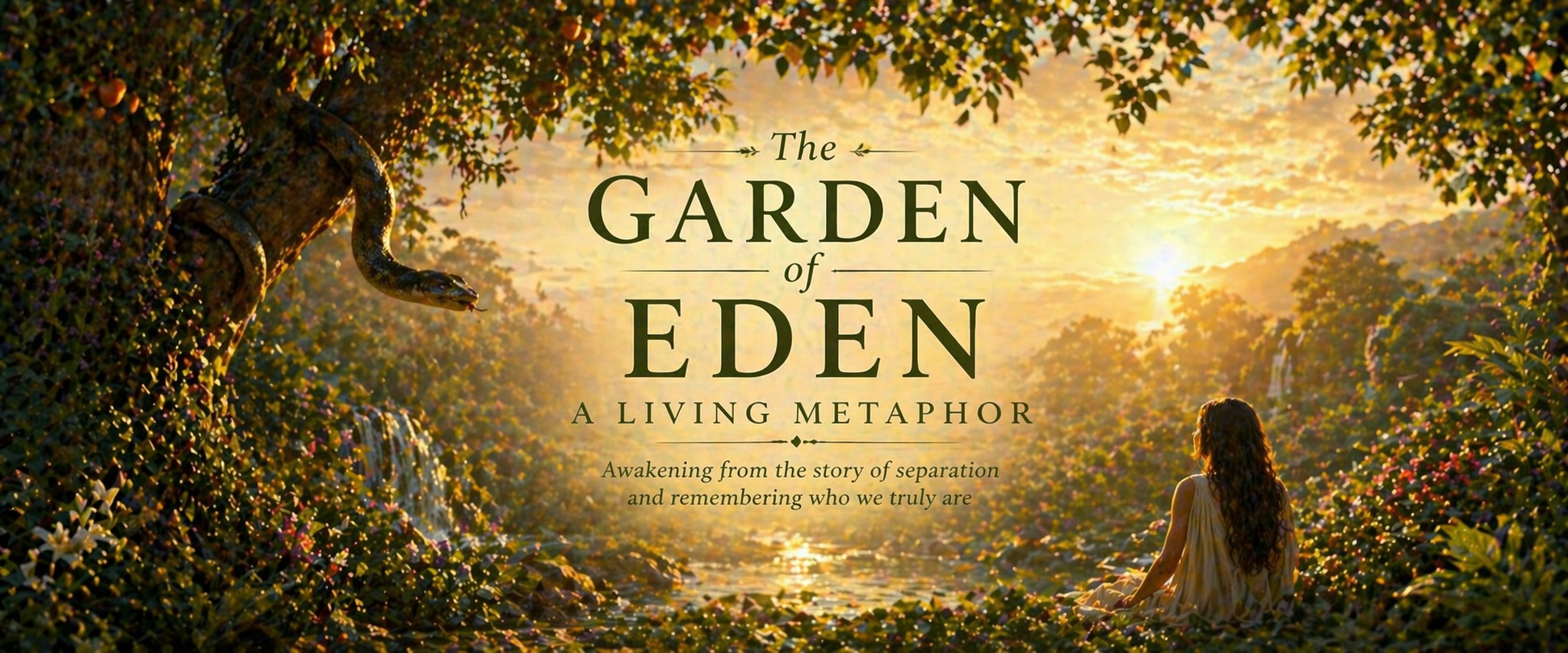
The Garden of Eden: A Living Metaphor
The story of the Garden of Eden is more than an ancient tale. It is a timeless metaphor for the human journey — a mirror held up to the soul, reflecting the very process by which we forget, and eventually remember, who we are. Its wisdom is as relevant today as it was thousands of years ago, because the drama it describes is not something that happened once, long ago, in a faraway place. It is something that unfolds inside each of us, every single day.
At birth, we arrive in innocence. Pure awareness. Untouched by judgment or fear. A newborn does not wonder whether it is lovable, worthy, or enough. It simply is. It breathes, it feels, it rests in being. This is our original state — and in a very real sense, it is our true home.
Yet as we grow, something begins to happen. We internalize language. We absorb labels. We inherit the stories of those around us — stories about the world, about other people, and most painfully, about ourselves. These inherited voices slowly layer over our original awareness, until we can barely hear the quiet truth underneath. We are told who we should be, what is good and bad, what is acceptable and shameful. We learn to edit ourselves. We learn to perform. We learn to fear.
And in doing so, we become separated — not from God, not from some distant paradise, but from the truth of who we already are: love, joy, and authentic presence.
Eden = Pure Awareness and Innocence
In the beginning, Adam and Eve lived in harmony. They walked in the garden, present and connected, simply being. There was no inner chatter. No commentary. No judgment. No comparison. No running list of what was missing or wrong. Just direct experience — the breeze, the light, the breath, each other.
This is Eden. It is not a location on a map. It is a state of consciousness — the state of being fully here, before the mind divides the world into this and that, me and you, good and bad. It is the awareness you are right now, beneath every thought.
The Snake = The Voice of Knowledge (the Lie)
The serpent's temptation to eat from the Tree of Knowledge of Good and Evil represents the intrusion of judgment. It is the subtle whisper that says: there is a better way to be than simply being. You must know. You must judge. You must measure yourself.
The moment the fruit is eaten, duality enters the garden. Suddenly there is good and evil, right and wrong, naked and clothed, worthy and unworthy. Adam and Eve look down and, for the first time, feel shame. They hide.
This is the pivotal moment — not because they broke a rule, but because they traded presence for the endless chatter of the mind. They stepped out of direct experience and into a story about experience. They believed the lie of separation.
We do this too. Every time we listen to the voice in our head that tells us we are not enough, that we must prove ourselves, that we must be different than we are — we eat the fruit all over again. We take on shame. We take on fear. We take on self-doubt. And we leave the garden.
The Teaching
The mind is a storyteller. This is what minds do. They narrate, compare, worry, plan, and judge. There is nothing wrong with that — until we confuse the story for the truth. Until we mistake the narrator for the self.
The voice in your head is not you. It is a voice you are aware of. And that which is aware is infinitely closer to who you really are than any thought could ever be.
When we identify with the voice, we lose connection to presence. Instead of living in love, we become entangled in thought, judgment, and fear. We walk around performing a character we believe we must be, exhausted from the weight of a self that was never real to begin with.
The Healing Path Back to Eden
The good news hidden inside this ancient story is that Eden is not lost. It was never a place we could be banished from. It is the awareness we already are, temporarily obscured by the stories we've inherited and believed. The path back is not a journey forward in time — it is a return to what has always been here.
Recognize. The voice in your head is not you. Notice it. If it is speaking, then who is listening? That listener — silent, spacious, aware — is closer to your true self than any thought could ever be.
Return to truth. Question your beliefs. Not with cynicism, but with curiosity. Ask: Is this actually true? Or is it something I was taught to believe? Most of the suffering we carry is built on inherited stories we never chose.
Practice presence. Cultivate silence. Cultivate stillness. Cultivate self-love. Not as an achievement, but as a remembering. Presence is not something you create — it is what remains when the noise quiets.
Live authentically. Root your life in direct experience, not in inherited lies. Let your choices flow from what is real and alive in you, rather than from fear of what others might think or who you were told to be.
Coming Home
At the Garden of Eden, this metaphor guides our mission: to help people awaken from stories of separation and rediscover the wholeness of who they truly are.
You do not have to earn your way back to the garden. You do not have to be good enough, spiritual enough, or healed enough. You only have to notice — gently, again and again — that the voice telling you otherwise is not you.
Beneath every story, beneath every fear, beneath every inherited label and borrowed belief, the garden is still here. Still whole. Still waiting.
You never actually left.
Join Our Community
Become a member to access exclusive events, workshops, and our ministry community.
Become a Member →