Truth: Separating the Signal from the Noise.
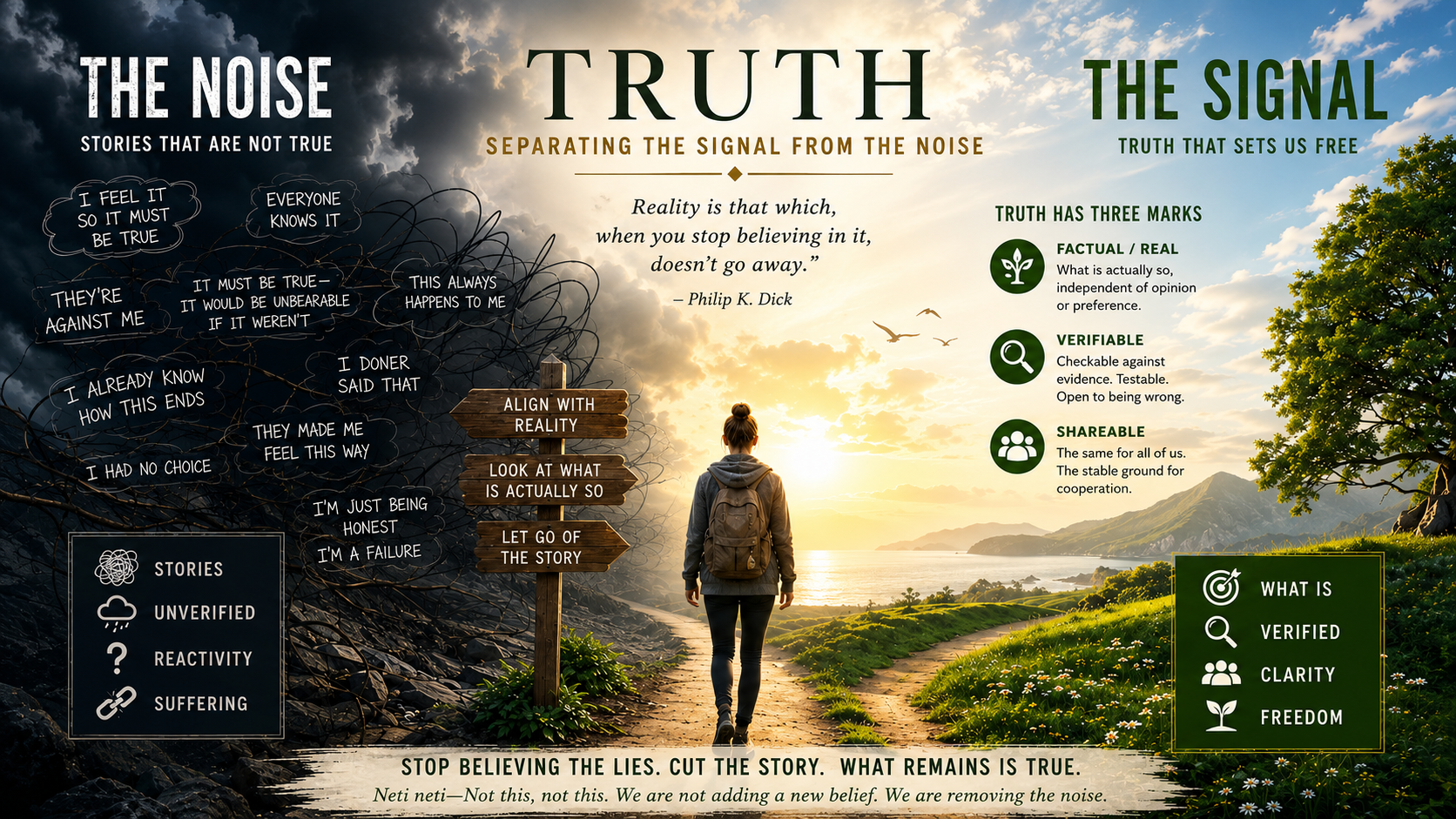
We suffer because we believe lies—stories that are not true.
A lesson on Truth: separating the signal from the noise
――――――――――――――――――――――――――――――――――――――
The key to success in any life, any relationship, any adventure, is the same: align with reality—that which is true. Reality is not negotiable. We do not get to vote on it. We can only align with it or collide with it, and suffering is the sound of the collision.
Most of our suffering is not caused by what is happening. It is caused by the “stories” we tell about what is happening—explanations, fears, and identities that we mistake for the thing itself. When we cut the story away and look at what is actually so, the suffering loses its fuel.
This is the oldest spiritual instruction there is, restated plainly: stop believing the false, and what remains is true. The Vedantic discipline of “neti neti”—“not this, not this”—is exactly this work of subtraction. We are not adding a new belief. We are removing the noise.
What truth is
“Reality is that which, when you stop believing in it, doesn’t go away.”
— Philip K. Dick
Truth is correspondence with reality—a statement is true when it matches how things actually are. That is the whole definition. The old image of map and territory is the clearest way to hold it, but only if we keep three things separate where the popular version keeps two.
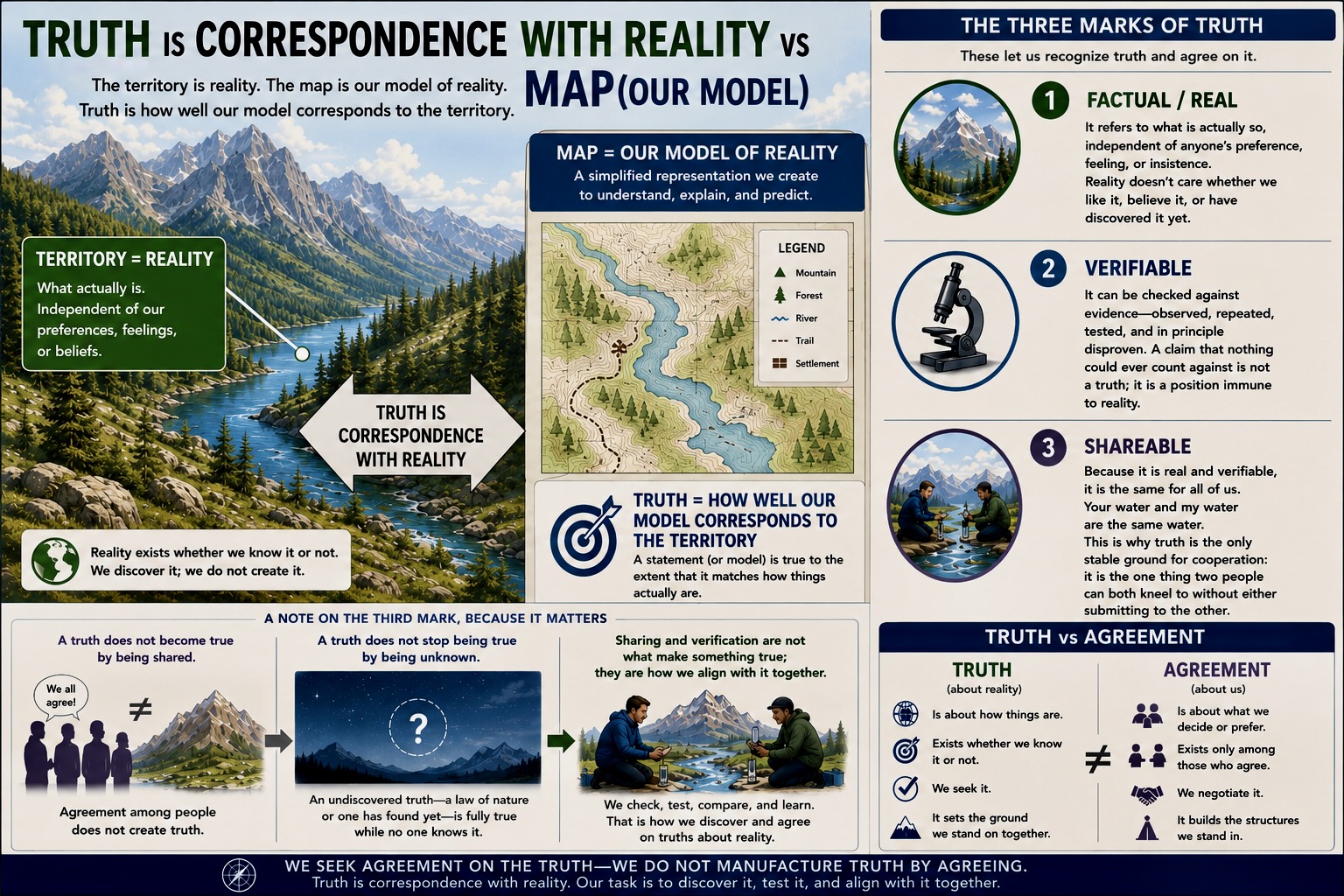
Reality is the territory—what is actually so, whether or not anyone has charted it. The map is our model of it—our perception, our description, the story we hold about how things are. And truth is neither of these. Truth is the relationship between them: how faithfully the map corresponds to the territory.
It is tempting to say “truth is the map.” That is the common mistake, and it quietly loses the most important of the three terms. A map is not true or false in itself; it is accurate or inaccurate relative to the territory it claims to represent. Truth is the degree of that fit. This is why we can hold a map with total conviction and still be wrong: conviction is a feeling about the map, while truth is a property of the correspondence—and the two can come apart entirely. We do not possess truth the way we possess a map. We earn it, more or less, by bringing the map into alignment with what is.
Truth has three marks that let us recognize it and, crucially, agree on it together:
1. Factual / Real.
It refers to what is actually so, independent of anyone’s preference, feeling, or insistence. Reality doesn’t care whether we like it, believe it, or have discovered it yet.
2. Verifiable.
It can be checked against evidence—observed, repeated, tested, and in principle disproven. A claim that nothing could ever count against is not a truth; it is a position immune to reality.
3. Shareable.
Because it is real and verifiable, it is the same for all of us. Your water and my water are the same water. This is why truth is the only stable ground for cooperation: it is the one thing two people can both kneel to without either submitting to the other.
A note on the third mark, because it matters: a truth does not become true by being shared, and it does not stop being true by being unknown. An undiscovered truth—a law of nature no one has found yet—is fully true while no one knows it. Sharing and verification are not what make something true; they are how we align with it together. This is the difference between truth (which is about reality) and agreement (which is about us). We seek agreement on the truth—we do not manufacture truth by agreeing.
“My truth” is a category error
There is no such thing as “my truth.” There is my experience and there is my opinion, and confusing either of these with truth is the root of an enormous amount of noise.
My experience is real and valid. “I am in pain,” “I felt humiliated,” “this is what I saw”—this is first-person data, and no one can overrule it. Honor it.
My interpretation of that experience is an opinion until it is verified. “He humiliated me on purpose” is a story about another mind; it is testable, and it might be wrong.
The phrase “my truth” smuggles an unverified opinion in wearing the costume of truth, so that it cannot be questioned. It is, in plain terms, a way of declaring my private, unshared, unverified opinion is beyond challenge. That move is not strength. It is a small act of narcissism—the self insisting reality bend to it. The mature alternative is simple and disarming: “That is my experience, and here is my opinion about it. Let’s find out what’s true.”
Why Our Feelings Are Not True
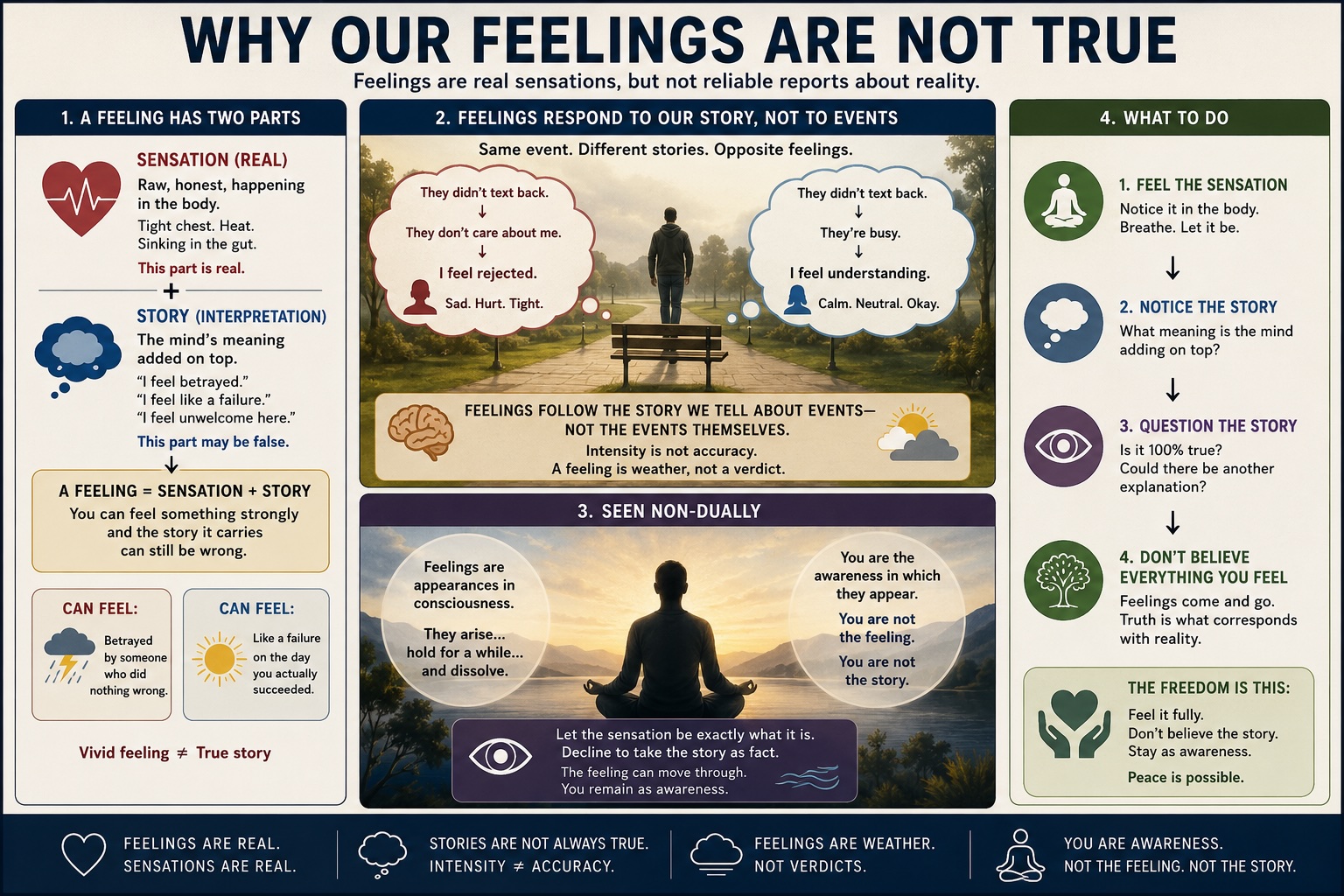
Feelings are real—you actually feel them—but they are not true in the sense of being reliable reports about reality. That is the distinction worth drawing.
Here is the simple version. A feeling is a sensation plus a story. The sensation is honest: a tightness in the chest, heat in the face, a sinking in the gut. That part is just happening. But the feeling we name—“I feel betrayed,” “I feel like a failure,” “I feel unwelcome here”—is that raw sensation already wrapped in an interpretation. And the interpretation is where truth and feeling part ways. You can feel betrayed by someone who did nothing wrong. You can feel like a failure on the day you actually succeeded. The feeling is vivid; the story it is carrying may be flatly false.
The reason this happens is that feelings respond to our thinking about events, not to events themselves. Two people meet the identical circumstance and feel opposite things, because each is telling a different story about what it means. The feeling then arrives with total conviction—it presents itself as evidence, as though “I feel it strongly” meant “it is so.” But intensity is not accuracy. A feeling is a weather system passing through awareness, not a verdict awareness has reached.
Seen through a non-dual lens, this points somewhere specific: feelings are appearances in consciousness, arising and dissolving like everything else that is witnessed. What you are is the awareness in which they appear—not the feelings themselves, and not the stories they ride in on. Seeing that a feeling is “not true” does not mean suppressing it or arguing with it. It means letting the sensation be exactly what it is while declining to take its story as fact. The feeling can move through, because you are no longer mistaking it for the truth about who you are or what is actually happening.
The collision, felt from the inside
If suffering is the sound of the collision, negative emotion is the experience of it. The crash is not an abstraction happening somewhere out in the world—it is felt, here, as anger, fear, grief, shame, resentment. These are not problems arriving from outside. They are the sensation of a thought meeting what is and not matching it.
Look closely at the structure. On one side is a thought—an expectation, a demand, a story about how things should be: “He should have called.” “This should not be happening.” “I should be further along by now.” On the other side is what is actually so. When the two diverge, the gap registers in the body as a negative emotion. The emotion is the felt size of the collision. A lightly held thought meets the same event and barely registers; a tightly gripped one meets it and the whole system shudders. Same reality—different grip, different impact.
This is why the emotion is not your enemy, and not a verdict about the world. It is information about the fit between your map and the territory—the felt signal that a story you are holding has just met reality and lost. The usual response is to demand that reality change to match the story, to insist the territory redraw itself to fit the map. That demand is the collision, renewed and renewed. The other response is available far more often: loosen the story. Hold it as “this is what I wanted” rather than “this is what must be.” The fact remains exactly as it is; the charge around it drops, because there is less held position for reality to crash into.
Notice what this does and does not ask. It does not ask you to pretend the painful thing isn’t painful, or to feel good about what is genuinely bad. The sensation is honest, and it is allowed to move through. What dissolves is the second layer—the story riding on top of the sensation, the silent claim that reality owed you something other than what it delivered. When that claim is set down, the collision has nothing left to strike.
The Signal vs. The Noise
Common stories people tell—and the truth beneath them. Every thought can be sorted. Either it moves you toward reality (signal) or it wraps reality in a story (noise). Learning to hear the difference, in real time, is the entire practice.
The Noise / Story
The Signal / Truth
“That’s my truth.”
That’s my experience and my opinion—and it’s testable.
“I feel it strongly, so it must be true.”
A strong feeling is real data about me. It is not evidence about the world.
“Everyone knows it / everyone says so.”
Consensus is not proof. A shared belief can be shared and false. What’s the evidence?
“It must be true—it would be unbearable if it weren’t.”
Wishing and dreading are not methods of knowing. Reality is indifferent to both.
“It’s true because [the teacher / the book / the authority] said so.”
Authority can point to truth but cannot make it true. Where’s the grounding?
“I am a failure / I’m just not that kind of person.”
An identity-story. The verifiable claim is smaller: “This specific outcome happened once.”
“This always happens to me.”
A frequency claim—and therefore checkable. Count. Usually “always” dissolves.
“They’re against me.”
A story about hidden intentions. What is actually observable here, minus the motive I assigned?
“If it can’t be measured, it isn’t real.”
Also noise—the opposite error. Some real things aren’t yet measurable. Stay honest in both directions.
“I already know how this ends.”
A prediction dressed as a fact. The future is not yet shared verifiable reality.
“I had no choice.”
There were choices. Some had costs you weren’t willing to pay. That’s different from having none.
“They made me feel this way.”
Their action was real. Your interpretation of it is yours. Both matter—but they aren’t the same thing.
“I was just being honest.”
Honesty is about accuracy, not permission to harm. The question isn’t whether it was true—it’s whether it was necessary.
“I’m just trying to help.”
Intent and impact are separate data points. Good intent doesn’t erase real effect.
“It’s too late to change.”
A prediction about the future stated as a fact about the present. These are different claims.
“I don’t have time.”
Usually: “This is not my current priority.” That’s honest. “No time” often isn’t.
“I never said that.”
Memory is reconstructive, not recorded. “I don’t remember it that way” is more accurate—and more honest.
“That’s just how I am.”
A personality label worn as a shield. The verifiable claim is: “I have done this repeatedly.” That’s a pattern—not a sentence.
“I’m too tired to deal with this.”
Fatigue is real. Using it as a permanent deferral isn’t rest—it’s avoidance with a medical alibi.
The pattern under all of it: noise adds an unverified explanation and then treats the explanation as the event. Signal strips the explanation back off and stands on what’s actually so.
On stories—the part that needs care
It would be tempting to say all stories are noise. But that is too blunt, and it is not true—which would be a poor foundation for a lesson on truth.
A story is noise when it counterfeits truth—when it claims to be a verifiable fact about reality while it is actually belief, opinion, or emotion in disguise. These are the lies that make us suffer. They are the serpent’s whisper: a narrative that overwrites what is plainly so.
But a story can also be a finger pointing at the moon—a parable, a myth, a metaphor that carries a truth which bare propositions can’t. The Garden of Eden itself is such a story. It is not a claim about geography; it is a pointer toward the truth that our separation from the divine is illusion. Held as a pointer, it serves truth. Mistaken for the literal fact it gestures at, it becomes noise.
So the dividing line is not story vs. no story. It is honest pointer vs. counterfeit fact. A story is wholesome when everyone knows it is a finger and looks where it points. A story becomes a lie the moment we mistake the finger for the moon—the map for the territory, the menu for the meal.
This is also the most honest thing a ministry can say about its own teachings: we offer stories that point. Do not worship the finger.
On belief
Belief is a placeholder for the unknown. We can only believe in what we do not know—once a thing is verified, we no longer “believe” it, we know it. You may believe in Jesus because you never knew him personally. You do not believe you had a mother. You know it. This makes belief neither good nor bad in itself—it is a tool for operating in the dark. The danger is forgetting that the placeholder is empty. A belief honestly held says, “I don’t know this yet; I’m proceeding as if.” A belief dishonestly held forgets the “as if” and hardens into a story we will defend against reality itself. The first keeps us moving toward truth. The second is how a person ends up at war with what is.
The practice: cutting the noise
1. Catch the story.
Notice the moment an explanation, a motive, or an identity gets added to a bare fact. (“He’s late” → “He doesn’t respect me.”)
2. Return to the verifiable.
Ask: What do I actually know—what is shared, checkable, so? Strip everything else.
3. Re-label.
Name opinion as opinion, feeling as feeling, belief as belief. Reserve the word truth for what has earned it.
4. Hold beliefs lightly.
Where you must act without knowing, act—but keep the placeholder marked “unverified,” ready to dissolve the instant reality speaks.
5. Let reality be the authority.
Not the loudest voice, not the most cherished story, not even your own—only what remains when you stop believing the false.
This is the work at the Garden of Eden: not to acquire new beliefs, but to put down the ones that were never true. What remains, when the noise is gone, was always already the case.
――――――――――――――――――――――――――――――――――――――
Neti neti. Not this, not this—until only what is real is left standing.
Join Our Community
Become a member to access exclusive events, workshops, and our ministry community.
Become a Member →